
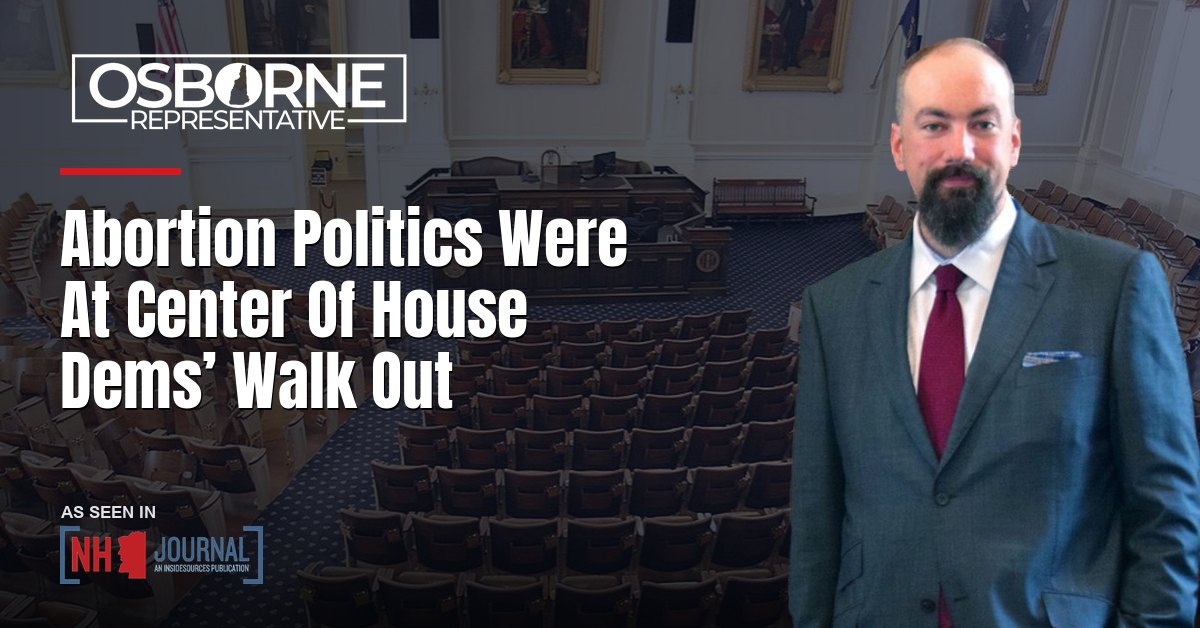
The New Hampshire House passed HB 625, the Fetal Life Protection Act banning abortions after 24 weeks except for medical emergencies, and HB 233, the Born Alive Infant Protection Act, after a failed Democratic attempt to deny a quorum. NH Journal reports House Majority Leader Jason Osborne defended both measures as protecting basic human rights.
Wednesday’s legislative throwdown began after the House passed HB 625, the Fetal Life Protection Act, which would ban late-term abortions — those after 24 weeks — unless there is a medical emergency that threatens the life of the mother.
NH Journal
NH Journal notes where the new restriction places New Hampshire among the states.
Four other states, Florida, Massachusetts, Nevada, and Pennsylvania have similar abortion restrictions while 19 states have banned the practice after 22 weeks.
NH Journal
Osborne addressed viability after the bill passed.
At 24 weeks the unborn are considered viable, and this bill allows them to have the same right to life as any other human,
House Majority Leader Jason Osborne
Democrats then tried to end the session, the outlet reports, but the effort failed.
Following the passage, Democrats tried to end the legislative session before the House could vote on HB233, the Born Alive Infant Protection Act. Their plan failed, and the House overwhelmingly passed HB233, which would require medical care for any baby born in any stage of development, as long as the baby is medically considered alive.
NH Journal
Osborne framed the second bill as a basic-rights question, according to NH Journal.
There is absolutely no reason why any child born alive should be left to die. I do not see this as a pro-choice vs. pro-life issue. This is an issue of basic human rights protected under our constitution
NH Journal
The House passed both measures after the failed quorum-denial attempt, with Osborne defending them as protecting basic human rights and citing fetal viability at 24 weeks.
The first bill placed New Hampshire among a small group of states with similar restrictions, while the second required medical care for any infant born alive, NH Journal reports. The coverage also notes the state’s existing abortion laws as context for the debate.
Osborne said he did not view the born-alive measure as a question of pro-choice versus pro-life, casting it instead as a matter of basic rights.
The House passed the born-alive measure overwhelmingly after the quorum attempt failed.
The first bill aligned New Hampshire with a handful of states that restrict abortion after 24 weeks.
Osborne cast the second bill as a question of basic rights rather than the abortion debate.
The coverage placed the votes against the backdrop of the state’s existing laws.
Nineteen states had banned the practice after 22 weeks, the outlet notes.
Osborne said the unborn are considered viable at 24 weeks.
The Democratic attempt to deny a quorum fell short, NH Journal reports.
The House passed the born-alive measure overwhelmingly.
Osborne said no child born alive should be left to die.
The first bill placed the state among others restricting abortion after 24 weeks.
The coverage noted the state’s existing abortion laws as context.
The House passed both bills after the quorum attempt failed.
Read the full story at NH Journal.