
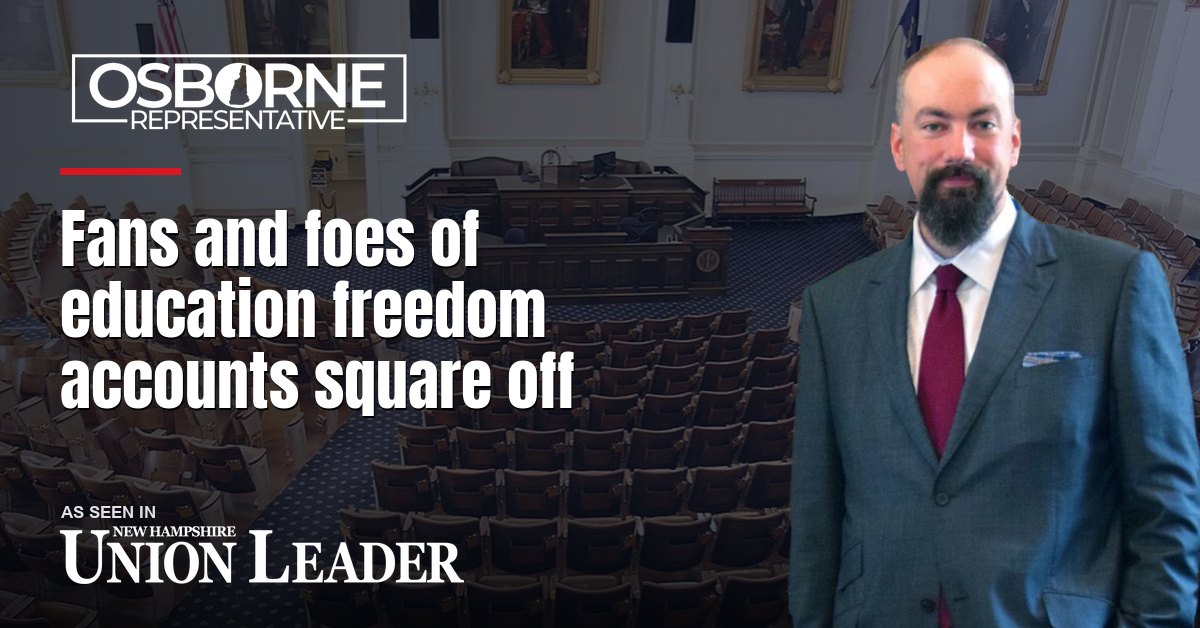
Advocates and foes squared off over legislation to make more families eligible for Education Freedom Accounts, and a closely divided House narrowly endorsed two bills to expand eligibility, the New Hampshire Union Leader reported. The accounts give parents taxpayer-paid grants for private, religious, alternative public or home schools.
House Majority Leader Jason Osborne argued the current income cap left too many families out.
House Majority Leader Jason Osborne, R-Auburn, said limiting these EFAs to families that earn 300% of the federal poverty level was unfair to higher-income families who still may need taxpayer relief.
the New Hampshire Union Leader
In a statement to the New Hampshire Union Leader after more than three hours of testimony, Osborne called the cap unfair: This current income cap is in fact discriminatory; it is discrimination to allow some students to use these funds to seek alternative educational opportunities, but not allow others.
He said the program’s track record justified opening it to more families.
“Given how wildly successful the program is, it is only natural we extend it to a larger portion of the population.”
the New Hampshire Union Leader
According to the New Hampshire Union Leader, one bill (HB 367) would raise the income cap to 500% of the federal poverty level, or $138,750 for a family of four, while a second from Rep. Erica Layon would make many at-risk students eligible regardless of income, including foster children, those with a disability and students who are bullied or attend an under-performing public school. At the time, 300% of the federal poverty level was $83,250 a year for a family of four.
Critics including National Education Association of New Hampshire President Megan Tuttle questioned the program’s accountability, the New Hampshire Union Leader reported, saying there was no evidence the accounts improve achievement and warning about discrimination.
“In addition, sending money to institutions that can discriminate against the makeup of their student body using public funds does not live true to the mission of serving all students,” Tuttle said.
the New Hampshire Union Leader
The votes came two weeks after the House had approved a separate bill to pare back EFAs, the New Hampshire Union Leader reported, and the article noted about 80% of the more than 3,000 families using the accounts were not enrolled in public schools when they applied. More Republicans were present in the chamber than two weeks earlier, when a similar effort narrowly lost.
Osborne added that the program’s rapid growth made broader eligibility a logical next step. He argued the existing cap drew an arbitrary line between families.
“Given how wildly successful the program is, it is only natural we extend it to a larger portion of the population.”
the New Hampshire Union Leader
The hearing came amid a broader fight over the program, including a separate House bill to limit EFAs to children who had attended public school the prior year. About 80% of the more than 3,000 families using the accounts were not enrolled in public schools when they applied.
Read the full story at the New Hampshire Union Leader.