
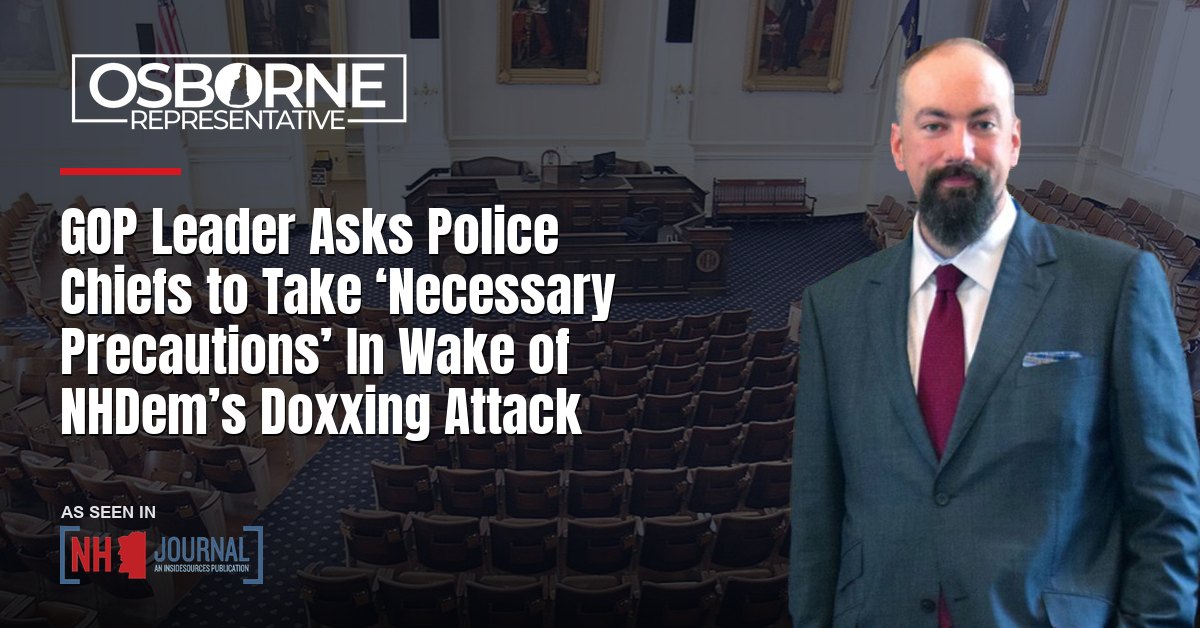
House Majority Leader Jason Osborne (R-Auburn) sent a letter to New Hampshire police chiefs asking them to take precautions for state representatives after a Democratic lawmaker published the names, home addresses, and phone numbers of Republican House members online, according to NH Journal. The reporting describes the move as a direct response to a doxxing episode that left targeted legislators facing harassment and threats in their own communities. Osborne’s letter, the outlet notes, urged local law enforcement to be aware of the situation as the legislative session got underway.
The letter framed the safety of lawmakers as the immediate concern, and NH Journal reported that the targeted representatives included members who had simply cast a procedural vote rather than opposed the underlying resolution. The contrast was notable because the resolution condemning the Capitol violence had ultimately drawn no opposition once it reached the floor, leaving the dispute centered entirely on the earlier rules question.
As NH Journal reported, the letter said the tweets carried real consequences for the lawmakers who were named, extending the dispute from the State House into their hometowns.
According to the letter, the tweets resulted in some state representatives being “constantly harassed and threatened” in their communities.
NH Journal
The NH Journal account also defined the term at the center of the controversy for readers, explaining what had happened to the Republican members whose information was shared.
Publishing private or identifying information about specific individuals on the internet, typically with malicious intent, is known as “doxxing.”
NH Journal
The dispute traced back to Convening Day, when Osborne and Democratic Leader Renny Cushing jointly offered a resolution condemning the January 6 violence at the U.S. Capitol. As NH Journal detailed, that resolution ultimately drew unanimous support after a separate vote on suspending the rules.
The rules suspension passed handily, with only 35 members — 33 Republicans and 2 Democrats — voting in opposition. Once the rules were suspended, the resolution condemning the D.C. violence passed unanimously.
NH Journal
According to the account, a Democratic representative then singled out the Republicans who had opposed the procedural rules suspension and posted their private details, even as the resolution itself had passed without dissent.
She also tweeted out their personal information, including their home addresses.
NH Journal
The episode began on Convening Day of the legislative session, which coincided with the events at the U.S. Capitol, and the show of unity in the chamber stood in contrast to the online dispute that followed. According to NH Journal, Osborne and Cushing had used the moment to bring the House together across party lines before the disagreement over the procedural vote spilled into public view.
The full reporting from NH Journal lays out the timeline of the resolution, the vote breakdown, and the response from House leadership, including Osborne’s appeal to police chiefs to keep watch over the members who had been targeted with the publication of their personal information.
For House Republicans, the incident underscored how a routine procedural disagreement on the chamber floor could carry consequences outside the State House. Osborne’s outreach to police chiefs, as NH Journal described it, was aimed at making sure local departments were prepared in case the harassment escalated, while the broader caucus pointed to the unanimous passage of the underlying resolution as evidence the dispute had been mischaracterized.
Read the full story at NH Journal.