
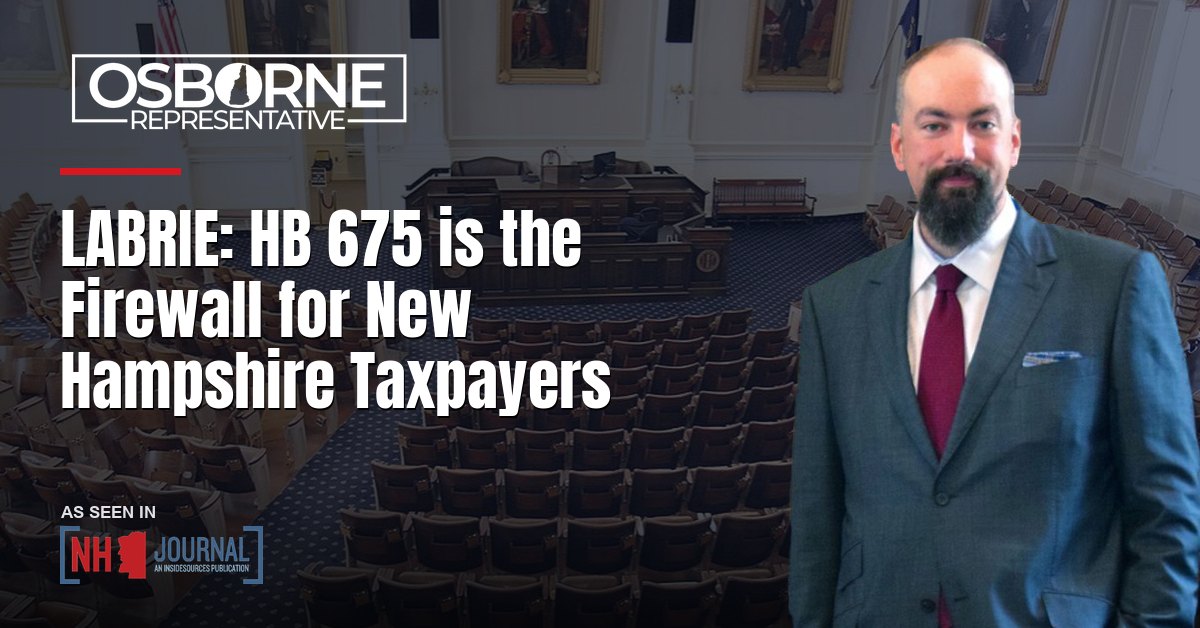
In an op-ed published by NH Journal, Rep. Brian Labrie argues that HB 675 is a long-overdue safeguard meant to protect New Hampshire taxpayers from rising property taxes when local districts will not cap their own spending. He frames the bill as a needed check on budgets that keep growing regardless of enrollment.
Labrie writes in NH Journal that lawmakers and residents increasingly see the current path as unsustainable.
In the halls of the State House and the coffee shops of every New Hampshire town, there is a growing consensus: the current trajectory of school spending is completely unsustainable.
NH Journal
He argues the state has a duty to step in where local boards will not.
While inflation eats away at household savings, many school district budgets continue to expand as if the laws of economics don’t apply to them. HB 675 is a long-overdue firewall for the Granite State taxpayer.
NH Journal
The heart of the bill, Labrie says, is linking spending to the number of students actually being served, NH Journal reports.
By tying the spending cap to the previous year’s enrollment (ADMR) alongside the Consumer Price Index (CPI), HB 675 finally introduces honest math to the process.
NH Journal
He describes the measure as ending a subsidy for empty desks.
We are ending the era of the “ghost student” subsidy, where taxpayers are forced to fund empty desks and administrative bloat.
NH Journal
Anticipating objections about local control, Labrie offers his own characterization of the status quo, NH Journal reports.
In reality, the current system is often a “tyranny of the few,” where a tiny fraction of voters at a school budget meeting can commit an entire town to millions in new debt.
NH Journal
Labrie’s central claim is that school spending has been allowed to climb on a “one-way ratchet,” rising when enrollment grows but rarely falling when it declines, NH Journal reports. He argues that tying the cap to the prior year’s student count and the Consumer Price Index would finally align budgets with the number of students actually being served.
The op-ed positions HB 675 as a backstop for communities where, in Labrie’s telling, local boards have been unwilling or unable to restrain their own budgets, NH Journal reports. He frames the two-thirds requirement to exceed the cap as a safeguard against a small group of voters committing an entire town to new spending, and as a source of predictability for families and seniors on fixed incomes.
Labrie’s op-ed presents HB 675 as a structural reform rather than a one-time fix, arguing that districts have had little reason to bring budgets down even as student populations fall, NH Journal reports. By tying the spending cap to the prior year’s enrollment and the Consumer Price Index, he writes, the bill would force budgets to reflect the number of students actually being served.
The piece is addressed largely to taxpayers and to families and seniors on fixed incomes, who Labrie says deserve more predictability from year to year, NH Journal reports. He frames the requirement of a two-thirds majority to exceed the cap as a check on what he calls a tyranny of the few, where a small group of voters can commit a town to millions in new debt.
Read the full story at NH Journal.